

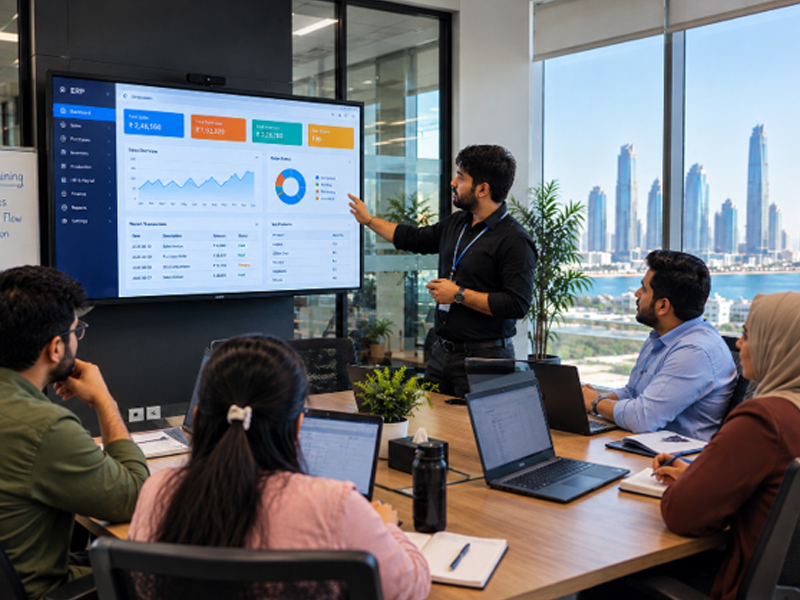
An ERP software encompassing various functional areas such as finance, sales, sourcing, stock, operations, and many more in the same platform is just the first step. Having access to the software does not imply that people will also know how to use it correctly. The real value emerges when people understand the workflows behind the system and feel confident carrying out their responsibilities within it.
This is precisely why ERP training services for UAE companies should concentrate on providing participants with practical knowledge rather than showing software functions. Employees have to understand the effect of their actions on processes such as documentation, authorization, reporting, and other business areas. At Digital Links ERP, we help organizations build that understanding through structured and role-focused learning.
ERP Adoption Does Not End at Go-Live
Implementing an ERP system marks a major achievement, but it is merely a step towards its actualization. When employees start to use the system, they face practical operations, acknowledged exceptions and approvals, and report-making.
Different departments operate in their own way in the same ERP environment. For example, finance department employees utilize the system for accounting and reporting functions; warehouse employees take advantage of the ERP solution in terms of goods movements and inventory management. A sales employee may work with customers and orders, while managers may need dashboards and approval functions.
Training becomes more effective when it reflects these differences. Rather than giving every employee the same information, organizations can provide learning that matches individual responsibilities.
Turning ERP Features Into Practical Working Skills
Employees don’t need to understand all the available functions in an ERP platform. What is essential is knowing how to perform functions relevant to their tasks and how this helps in getting things done.
Creating a purchase transaction may seem to be a simple operation, but the data entry can affect the inventory, supplier information, approvals, accounting, and reporting. When employees understand these connections, they are more likely to enter information accurately and follow the correct process.
Effective ERP user training Dubai organizations rely on should therefore connect software functions with actual business workflows. Instead of learning isolated buttons and menus, employees learn how a process moves from one stage to another.
At Digital Links ERP, we focus on making this connection clear. Our approach helps users understand not only what to do within the software, but also how their work contributes to the wider business process.
What Effective ERP Training Should Give Employees
The most effective training courses are organized based on the requirements of the target users instead of the features of the application.
- Role-focused learning: People study the modules, transactions, reports, and processes that are relevant for them.
- Practical navigation: Users gain confidence moving through the screens, records, and functions they use regularly.
- Accurate data handling: Training emphasizes the need for inserting the correct and full information into the integrated system.
- Process awareness: Employees learn how their actions can influence other departments, approvals, reports, stocks, or financial records.
- Error awareness: Users get acquainted with frequent problems they may face and know when they need help to solve them.
- Continued development: Refresher sessions can reinforce knowledge when employees need more practice or processes change.
This approach makes training more useful because employees can immediately connect what they learn with what they do at work.
Why ERP Learning Should Continue Beyond Implementation
In the weeks following the implementation of a system, there may be instances of discrepancies that were not perceived during the first training program, when the employees were being introduced to the system’s functionalities.
This is why ERP software training UAE companies provide should not always be treated as a one-time event. In fact, follow-up training is able to clarify recurring problems, help to reinforce significant processes, and unveil supreme applications of the software.
Regular training is also useful when the company’s staff is renewed. Without a structured training process, new users may depend on colleagues to explain procedures, creating the possibility of inconsistent practices.
A continuing learning strategy helps maintain a common understanding of how the ERP system should be used.
Making Complex Systems Easier to Understand
ERP platforms can initially appear complicated because they bring many business functions together. Employees can become overwhelmed if they are introduced to too many features before understanding the processes relevant to their roles.
A more practical approach is to build knowledge progressively. Users can first learn the tasks they perform most frequently and gradually develop familiarity with more advanced functions.
This also allows organizations to accommodate employees with different levels of technical experience. Someone comfortable with business software may progress quickly, while another employee may need additional time and guided practice.
Our objective at Digital Links ERP is to make ERP learning approachable without removing the important details employees need to perform their roles correctly.
Training That Reflects the Way Your Business Works
No two organizations operate in exactly the same way. They may use different approval structures, terminology, responsibilities, reporting requirements, and internal procedures, even when they use similar ERP platforms.
This is where ERP employee training services can provide greater value than generic software demonstrations. Training can be organized around departments, user roles, business processes, and specific operational requirements.
A finance team may need detailed guidance on accounting transactions and reporting. Procurement users may focus on purchase workflows and supplier information. Warehouse teams may require more attention to stock movements, transfers, and inventory records.
When training reflects these responsibilities, employees spend more time learning what they actually need and less time working through information that has little relevance to their roles.
Building Better Habits Through Realistic Practice
ERP accuracy is strongly connected to user behavior. If employees enter inconsistent information, overlook required fields, or misunderstand a process, the resulting data can affect other areas of the organization.
Training provides an opportunity to establish good habits from the beginning. Employees can learn why certain information matters, when approvals are required, how records should be maintained, and how their actions influence other teams.
Practical exercises make this learning more effective. Working through realistic scenarios allows employees to experience the workflow instead of simply watching someone demonstrate it. It also gives them an opportunity to ask questions and understand mistakes before they occur during real operations.
Knowing Whether Training Has Made a Difference
Training should ultimately be measured by how confidently and accurately employees use the system. Attendance alone does not demonstrate successful adoption.
Organizations can look at indicators such as transaction accuracy, repeated user errors, support requests, process consistency, and the use of relevant ERP functions. Employee feedback can also identify areas where additional training may be useful.
For companies investing in ERP training services UAE, this type of evaluation helps turn training into an ongoing improvement process rather than an isolated activity.
Making ERP Knowledge Part of Everyday Operations
ERP adoption becomes stronger when employees understand that the platform is part of the organization’s working environment rather than simply another application they have been asked to use.
Managers can reinforce correct processes, experienced users can support new employees, and refresher sessions can address changing requirements. Over time, these practices help create greater consistency across departments.
At Digital Links ERP, we see training as part of this broader transition. Our goal is to help businesses develop teams that can use their ERP environment confidently while understanding the importance of accurate and connected information.
From Software Access to Genuine User Confidence
An ERP system has the potential to offer great capabilities; however, the advantages of this system only come when employees seem to know how to make use of the offered capabilities. Training creates a connection between the capabilities of software used in the organization and how work is accomplished.
Whether the organization is preparing for the implementation, working on exploits, training the employees, or optimizing the utilization of the existing system, structured learning can help to improve the adoption of the system.
Companies that look for ERP user training Dubai can benefit greatly from the programs devised around real responsibilities and workflows. Organizations considering ERP software training UAE can focus on practical learning that employees can apply immediately. For broader workforce development, ERP employee training services can provide a structured way to maintain knowledge as teams and processes evolve.
At Digital Links ERP, we help organizations go from having a simple ERP system to an organization with its employees trained to use the ERP system properly.
Your ERP should not feel like another system employees have to learn. Turn it into a confident part of everyday work with training built around your people, processes, and goals.

